How does pension tax-free cash work — and what’s the £17,400 mistake?
You can normally take 25% of a pension tax-free from age 55 (57 from 2028). The other 75% is taxed as income when you draw it. You don’t have to take it all at once — and taking it in slices, matched to your personal allowance, is usually what keeps the tax bill down.
Mr Pickles is 60 and has a £100,000 pension. He’s about to take money out. Handle it one way and he keeps almost all of it. Handle it another and he hands about £17,400 to HMRC — same pension, same money, one decision.
This article explains what tax-free cash actually is, when taking it makes sense, and how to avoid the most expensive mistake people make with it.
What is tax-free cash, exactly?
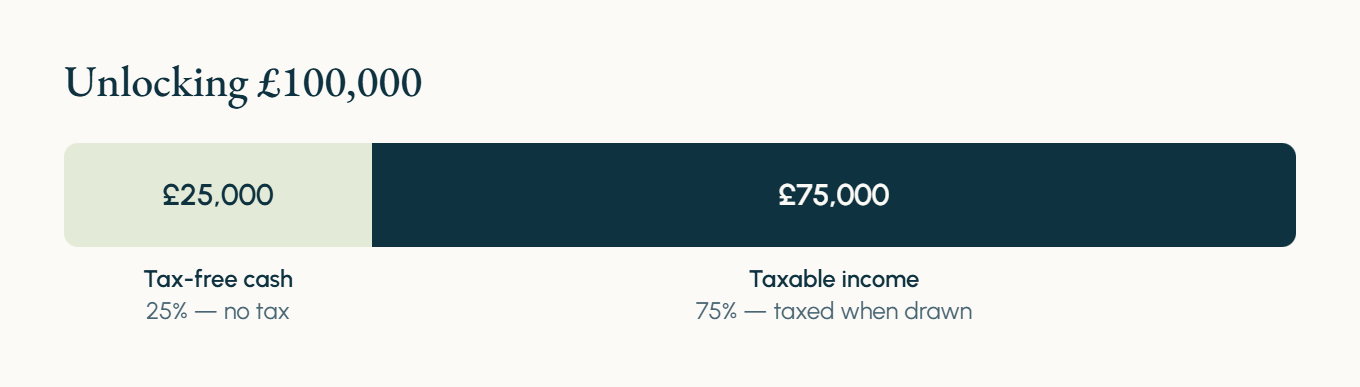
When you reach pension age you can normally take a quarter of your pension completely tax-free. The other three-quarters becomes taxable income when you draw it.
Taking money out has a technical name: crystallising. When you crystallise part of a pension it splits into two parts — the tax-free 25% and the taxable 75%. Anything you don’t touch stays uncrystallised: still invested, still untaxed, waiting.
So if Mr Pickles crystallised his whole £100,000, £25,000 would be tax-free and £75,000 would be treated as taxable income.
There is a lifetime cap on tax-free cash — the Lump Sum Allowance of £268,275 — but for most people it never comes into play.
When does taking it make sense?
“Because I can” isn’t a reason. Money out of a pension is money that’s no longer growing tax-free inside it. Six reasons that do hold up:
- Clearing expensive debt — a mortgage, loan or card, especially while rates are high. It also cuts the outgoings you have to fund every month in retirement.
- Helping family early. Gifting now starts the seven-year inheritance tax clock, and you see them enjoy it.
- Bridging to the State Pension. Stop work before it starts and you can take tax-free cash and draw taxable income up to your £12,570 personal allowance with no tax to pay. Once the State Pension arrives it uses up most of that allowance, so the in-between years are the window.
- Passing money to a spouse after 75. Die after 75 with the pension untouched and whoever inherits pays income tax on every withdrawal. Tax-free cash taken while you’re alive is already out — they keep every pound.
- Topping up an ISA. It carries on growing tax-free, and ISA withdrawals aren’t taxable either. Up to £40,000 a year between a couple.
- You’ve hit the cap. Once your 25% reaches the £268,275 Lump Sum Allowance, leaving more in the pension only ever grows the taxable part.
Every one of these assumes you take the money deliberately. Because how you take it matters as much as the fact it’s tax-free.
What is the £17,400 mistake?
The biggest mistake is taking too much, too fast.
Say Mr Pickles crystallises the whole £100,000 and draws all the taxable part in one tax year. His £25,000 tax-free cash is fine. But the other £75,000 lands as income, all at once:
| Slice of the £75,000 | Rate | Tax |
|---|---|---|
| First £12,570 (personal allowance) | 0% | £0 |
| £12,570 – £50,270 | 20% | £7,540 |
| £50,270 – £75,000 | 40% | £9,892 |
| Total | £17,432 |
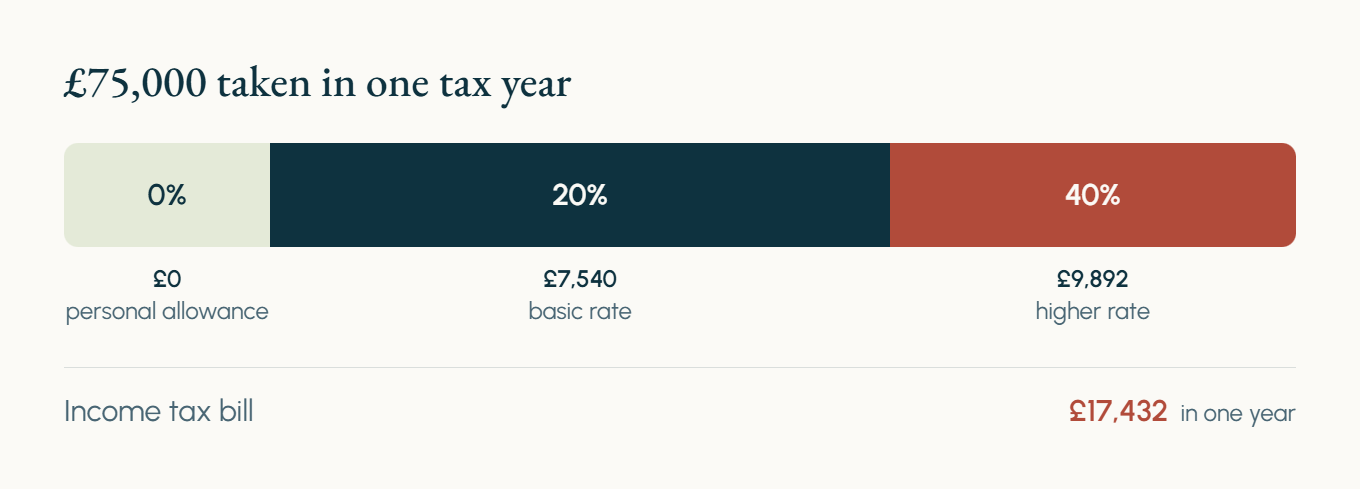
Almost all of it was avoidable. Spread the same £75,000 across several tax years, keeping each year’s slice inside his £12,570 personal allowance, and he pays no income tax on it at all.
Why does spreading it out work?
A modern pension is flexible. Three things make the slow approach possible.
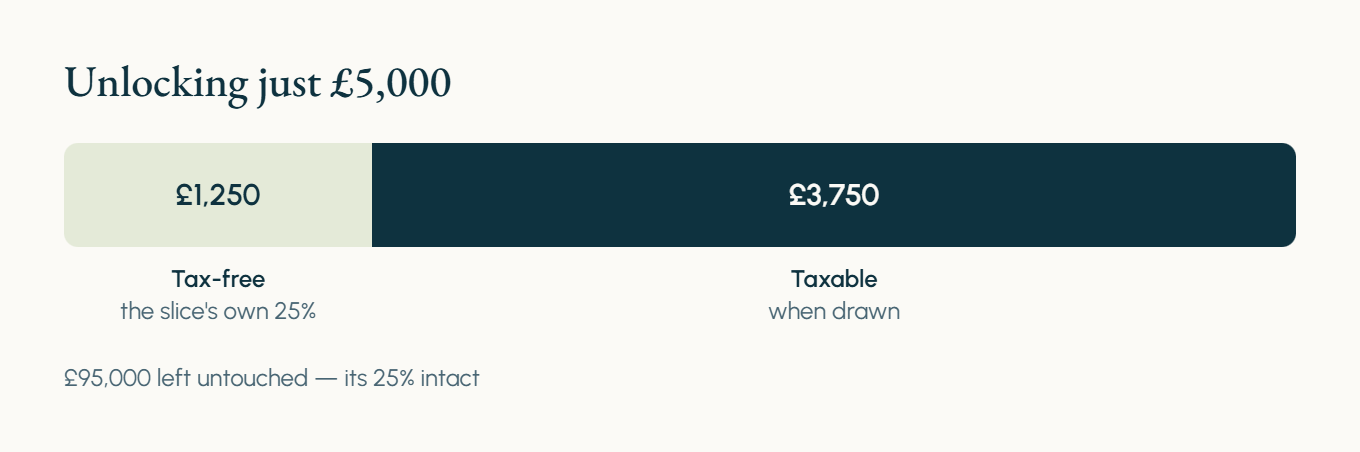
You can take it in slices. Every slice you crystallise comes with its own 25% tax-free. Unlock £5,000 and £1,250 is tax-free; the other £95,000 stays untouched, its tax-free quarter intact.
You choose the mix. Each withdrawal can be tax-free cash, taxable income or a blend — so you dial the taxable part up or down each year to fit whatever personal allowance you have spare. One caution: the moment you draw any taxable income, the amount you can pay into pensions drops to £10,000 a year (the Money Purchase Annual Allowance). If you’re still contributing, dial carefully.
Tax-free cash comes first, or alongside — never behind. That’s the one hard rule.
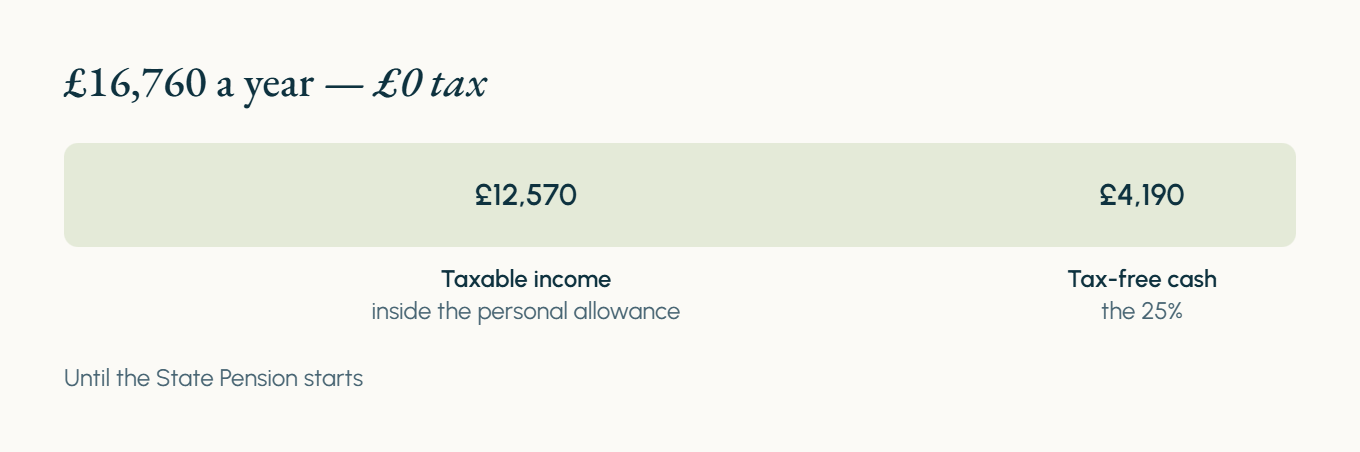
Put those together and you get the classic move. Mr Pickles takes £16,760 a year: £12,570 taxable, which sits inside his personal allowance, plus £4,190 tax-free cash. Completely tax-free, year after year, until his State Pension starts.
What if your allowance is already used up?
If you have a salary, rental income or the State Pension, your allowance is probably spoken for and you’re likely a basic-rate taxpayer. Drawing both parts together still works well: a quarter of every withdrawal is tax-free and the rest is taxed at 20% — an effective rate of 15% on every pound.
And bear in mind the change from April 2027: unused pension funds will count towards inheritance tax. There’s less reason than there used to be to leave money sitting in a pension untouched.
- 25% of a pension can normally be taken tax-free; the other 75% is taxed as income when drawn.
- Take it for a reason — debt, family, bridging to the State Pension, an ISA — not because you can.
- Drawing all the taxable part in one year can cost around £17,400 on a £100,000 pot.
- Take it in slices, matched to your personal allowance, and the same money can be drawn with no tax at all.
- From April 2027 unused pensions count towards inheritance tax — another reason not to hoard.