
Why do smart people make poor money decisions?
Your brain runs on shortcuts. They are fast and usually good enough, but with money they turn into predictable errors called behavioural biases. None of them make you unintelligent. They make you human. The trouble is that they rarely feel like mistakes at the time, which is why sensible people keep making them. Below, a year in the life of Mr Pickles shows ten of them at work.
What are behavioural biases?
Meet Mr Pickles. He is 58, has a comfortable pension pot, and has never made a rash financial decision in his life. He reads the papers, keeps a spreadsheet and sleeps well.
Like everyone, he makes thousands of decisions a day. Marmalade or Marmite. Which lane on the motorway. To cope, his brain uses rules of thumb. Psychologists call these heuristics: quick answers that need little effort. They are not built to find the perfect answer, only a fast one.
Three shape nearly every choice. Availability means we judge how likely something is by how easily an example springs to mind, so a rare plane crash feels more probable than the millions of safe landings. Representativeness means we sort things into categories at a glance and judge books by their covers. Affect means we go with our gut, so risks look small when we feel good and large when we feel low.
When the shortcuts still do not settle a question, we filter the facts through our values, opinions and past experience. Those filters are behavioural biases. There are over 150 on record. Ten come up again and again with money, and Mr Pickles is about to meet all of them.
How does Mr Pickles read information?
January: confirmation bias. A colleague mentions a technology fund that has done well. Mr Pickles is interested, so he does his research. He reads three glowing articles and one cautious one. He remembers the three. By the time he opens his spreadsheet he has already decided; the research was to make himself comfortable, not to test the idea. Psychologists call confirmation bias the mother of all biases, because it protects every other one.
February: framing. His pension provider writes to say that a fund has “preserved 92% of its value through a difficult year”. He reads it as reassuring. Had the letter said the fund “fell 8%”, he would have picked up the phone. Nothing about the fund changed. Only the frame did.
March: anchoring. Mr Pickles is comparing two investment platforms. One quotes a fee “reduced from 0.75% to 0.45%”. The other simply charges 0.40%. He chooses the first. It feels like a bargain, but only because of the first number he saw. The anchor set his judgement, not the value.
April: attentional bias. An email arrives promising “guaranteed 12% a year, fully protected”. It is the loudest thing in his inbox, and for an afternoon it holds his attention completely. He does not act on it, but he is surprised how long he spends thinking about it. This is exactly where scams operate: a promise big enough to crowd out the quieter question of whether it could possibly be true.
How does Mr Pickles feel?
May: overconfidence. After a good few months, Mr Pickles decides he has a knack for this. He starts checking prices daily and trimming holdings that look “tired”. Overconfidence is a normal human trait, and a useful one in most of life. The trouble is that it spikes at particular moments, and investing money is one of them. It is the bias that lets all the others in.
June: loss aversion. Markets wobble. His pot dips, then recovers within a fortnight. Nothing was spent, nothing was crystallised, and his retirement is still years away. But the two weeks it spent below its previous high bothered him far more than the months it spent above it pleased him. This is the £50 note effect: losing £50 hurts roughly twice as much as finding £50 feels good. For some people, that lopsided feeling ends up quietly setting their whole investment strategy.
July: present bias. He has been meaning to increase his pension contributions since the spring. A holiday comes up instead. Today’s version of Mr Pickles wins the argument, as he usually does, and the future version picks up the bill. Present bias is not greed; it is simply that the person who benefits from saving is a stranger you have not met yet.
August: illusion of control. Mr Pickles has been choosing his own funds. He is aware that a professionally managed portfolio would probably hold something similar, but his own choices feel safer, because he made them. He also notices, if he is honest, that when a joint decision with Mrs Pickles goes well it was his idea, and when it goes badly it was hers.
How does Mr Pickles read the crowd and the odds?
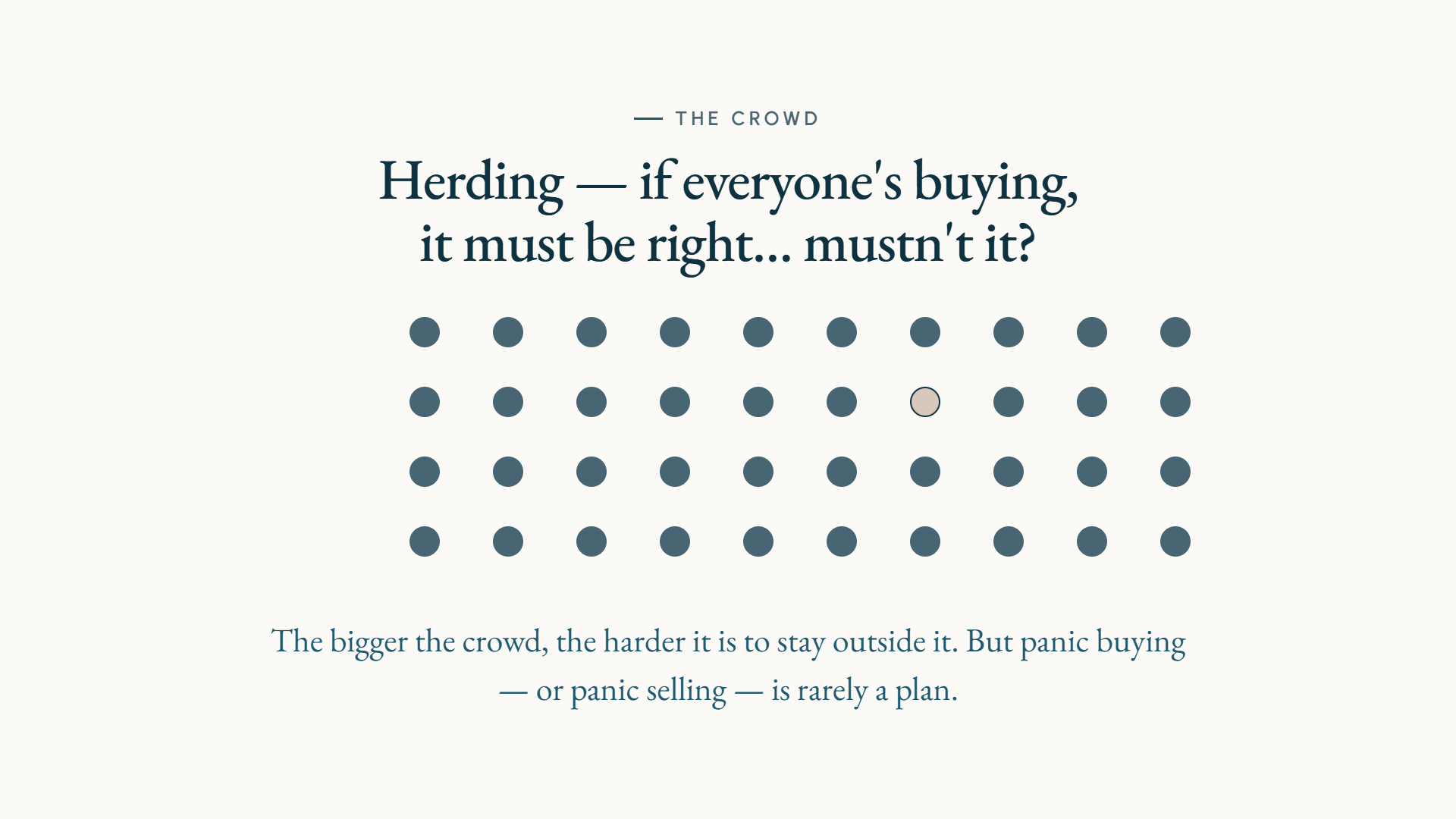
October: herding. Everyone at the golf club is talking about the same investment. If that many sensible people are buying, it must be right. Herd instinct has us copy the crowd without enough independent thought, and the more people who join in, the harder it becomes to stay on the outside. Panic buying and panic selling are the same instinct pointing in opposite directions, and neither is a plan.
November: probability neglect. Mr Pickles will happily drive four hours to avoid a one-hour flight, though the numbers say the drive is the riskier part of the journey. With money it works the same way. He worries about the dramatic, unlikely loss and feels relaxed about the slow, likely one, such as leaving too much in cash while inflation does its work.
| Group | Bias | What it looked like for Mr Pickles |
|---|---|---|
| How you read information | Confirmation | Researching a fund after deciding to buy it |
| Framing | “Preserved 92%” felt fine; “fell 8%” would not have | |
| Anchoring | A fee “cut from 0.75%” beat a lower fee with no story | |
| Attentional | An afternoon lost to a “guaranteed 12%” email | |
| How you feel | Overconfidence | Checking daily and trimming “tired” holdings |
| Loss aversion | A two-week dip that outweighed months of gains | |
| Present bias | The holiday that beat the contribution increase | |
| Illusion of control | His own fund picks felt safer than identical ones | |
| The crowd and the odds | Herding | Buying what the golf club was buying |
| Probability neglect | Fearing the dramatic loss, ignoring the slow one |
None of these were reckless. Nobody watching would have called Mr Pickles foolish. That is what makes biases expensive: they look like ordinary judgement from the inside.
Why is the risk you think you can take different from the risk you actually take?
Risk comes in two kinds. Subjective risk is how much you believe you can tolerate, and it is fuelled by every bias above. Objective risk is how you actually behave when a fall arrives.
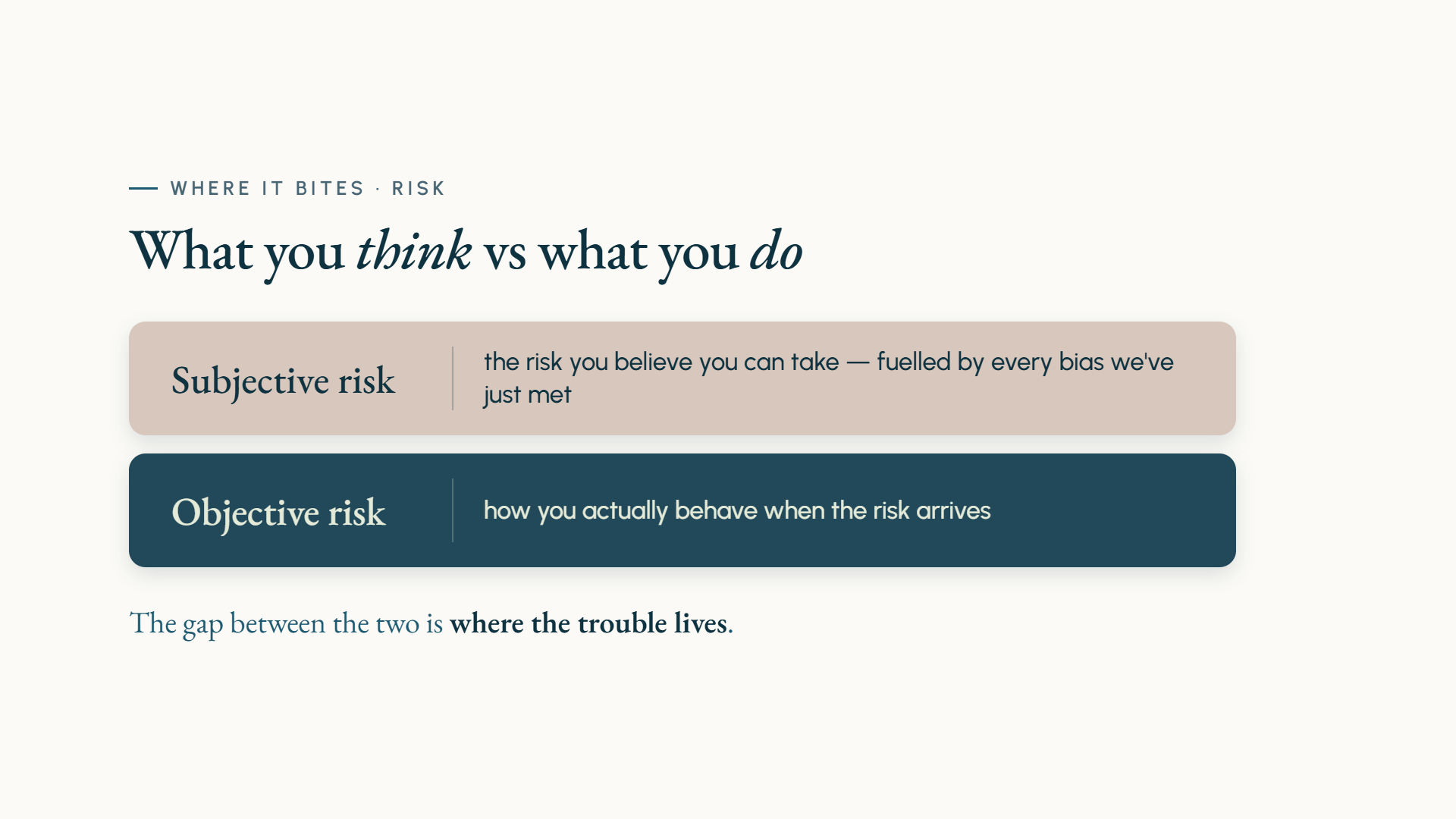
When Mr Pickles filled in a risk questionnaire in January, he described himself as comfortable with ups and downs. In June, a two-week dip had him reaching for the phone. Both answers were honest. They were just given by different versions of him.
Think of a skiing holiday. A friend suggests a harder run and of course you are up for it. Then you are standing at the top, looking down. Investing is the same. A hot tip sounds exciting right up until it falls in value.
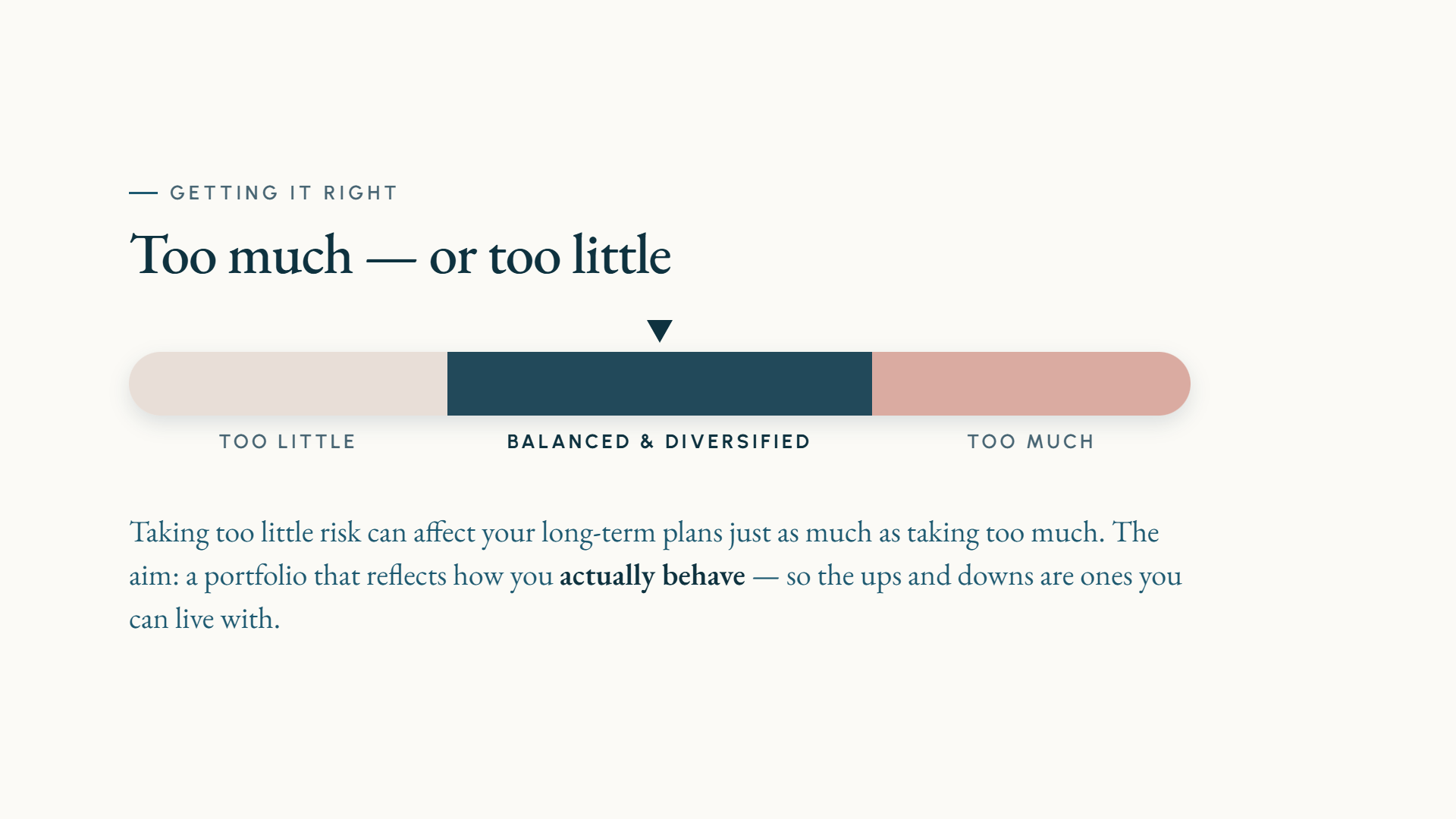
Taking too little risk can harm a long-term plan as much as taking too much, so the aim is not to avoid risk. It is a diversified portfolio built around how you actually behave, so the inevitable ups and downs cause less anxiety and fewer decisions made in June.
What habits help keep biases in check?
The gap between what we think and what we do never closes fully. Five habits narrow it, and Mr Pickles now uses all of them.
- Pause. Ask what the decision is actually based on. A step back in January would have shown him he had already decided.
- Sleep on it. Strong feelings make poor decisions. If it can wait until morning, let it. The June phone call could have.
- Check the source. Not all information deserves the same trust. The golf club is not a research department.
- Double-check. Do you have the full picture, or only the parts that agree with you? Reread the cautious article.
- Take your time. Talking through an important decision is not delay. It is part of the decision.
- Behavioural biases are normal mental shortcuts that misfire around money, and there are over 150 of them.
- Ten matter most: how you read information, how you feel, and how you read the crowd and the odds.
- They rarely feel like mistakes at the time, which is why intelligent, careful people keep making them.
- The risk you believe you can take and the risk you actually take are different; a portfolio should reflect the second.
- Pausing, sleeping on it, checking sources, double-checking and taking your time all reduce the damage.